Your agents run in your environment. The control plane never reaches in.
Govern, observe, evaluate and approve every agent you run — built for regulated environments, with EU AI Act compliance in the box. Your code, prompts and credentials never leave your infrastructure.
{{ c.title }}
{{ c.body }}
The paper trail that ships itself.
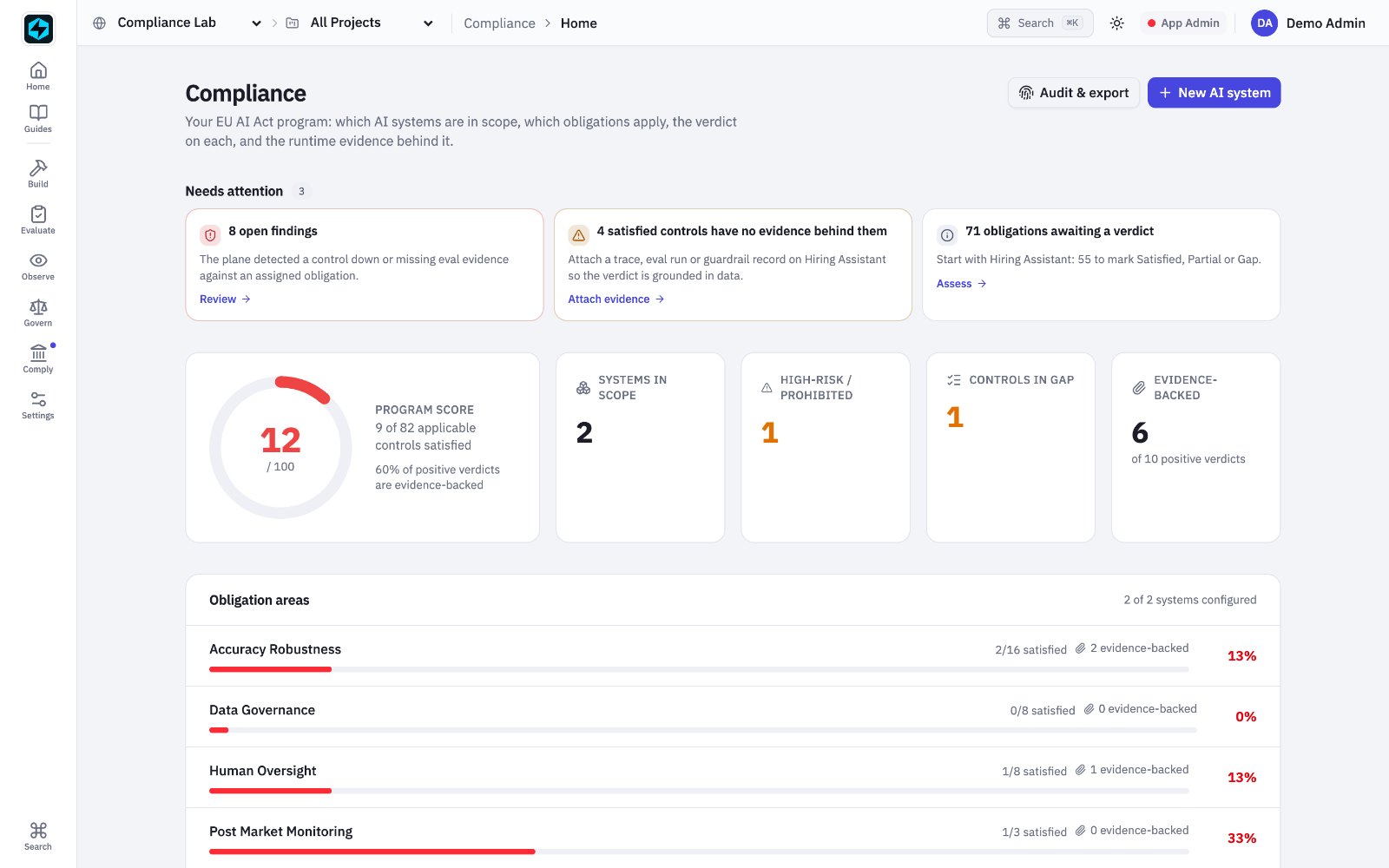
A harness without guardrails is just a sandbox. Governance wraps the runtime in EU AI Act compliance, accountability roles, prohibited-practice enforcement, and continuous monitoring — fed directly from the registry, traces, and evals already in the stack. When the auditor asks, the evidence is already there.
- →EU AI Act — high-risk classification, technical doc generation, conformity assessment over a library of 52 controls.
- →19-role accountability — Provider, Deployer, Importer, Distributor, mapped per agent.
- →Prohibited-practice enforcement — pre-flight policy check on every run.
- →Audit trails — every decision linked to prompt version, model version, memory snapshot, on a tamper-evident ledger.
- →Continuous monitoring — drift, bias, performance — alert on threshold breach. See which agents are registered, reporting, or dark.
- →Compliance reporting — one-click PDF for auditors, regulators, internal review.
Where the loop meets people.
An autonomous loop without humans is a liability. "Human in the loop" here means approving a production action before it happens — not a labelling queue. Your people meet the agent in streaming chat, approval queues, and shared sessions, with full audit.
- →Approval queues — durable HITL with timer-based escalation; pause for hours or days and resume where you left off.
- →Approve, modify, reject or expire — every resolution recorded in an org-wide, append-only ledger.
- →Session sharing — pin, comment, reassign, hand off.
- →Cost dashboards — tokens, runs, $ per role per agent, with quotas and hard caps.
See what happened — and what your controls decided about it.
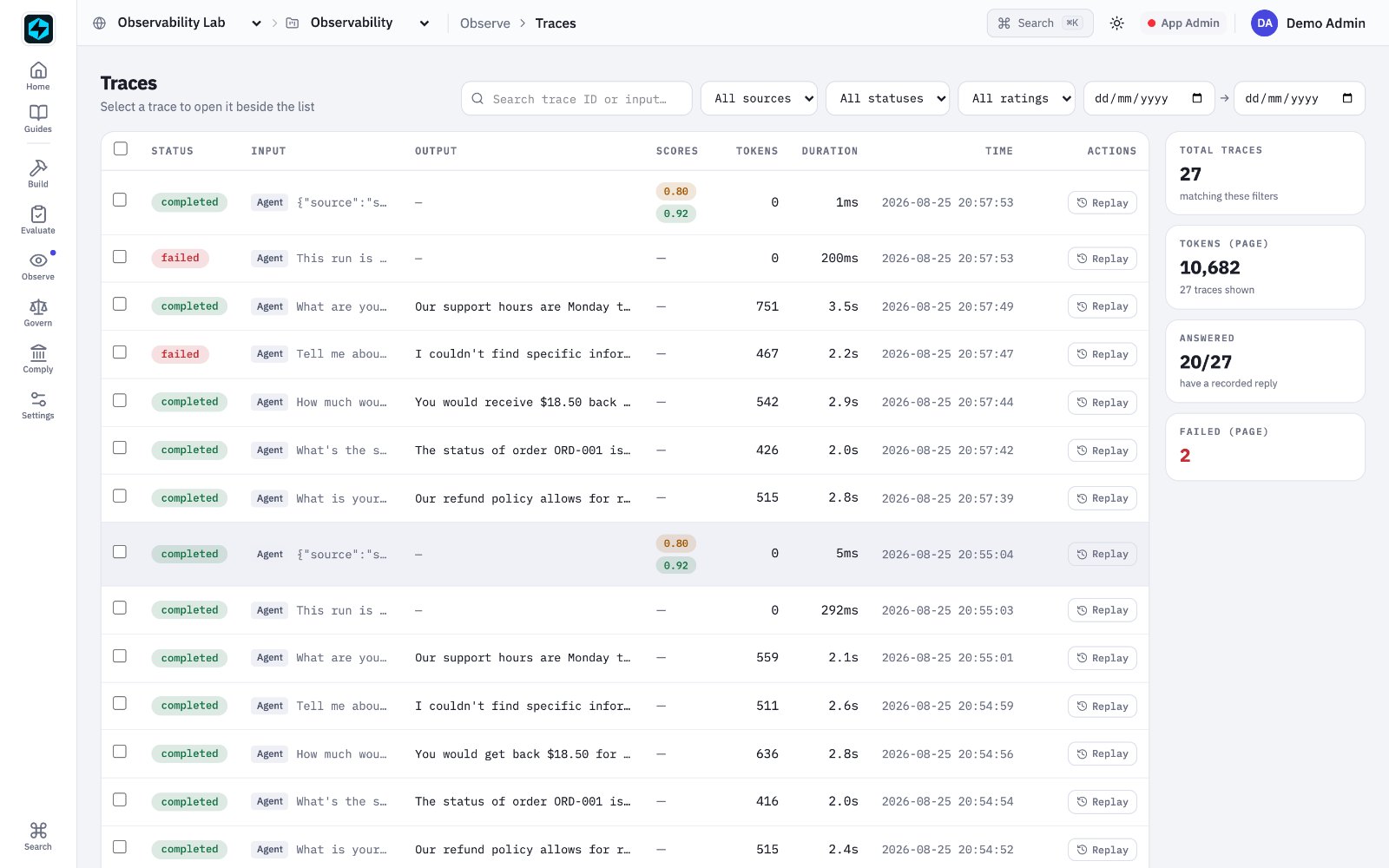
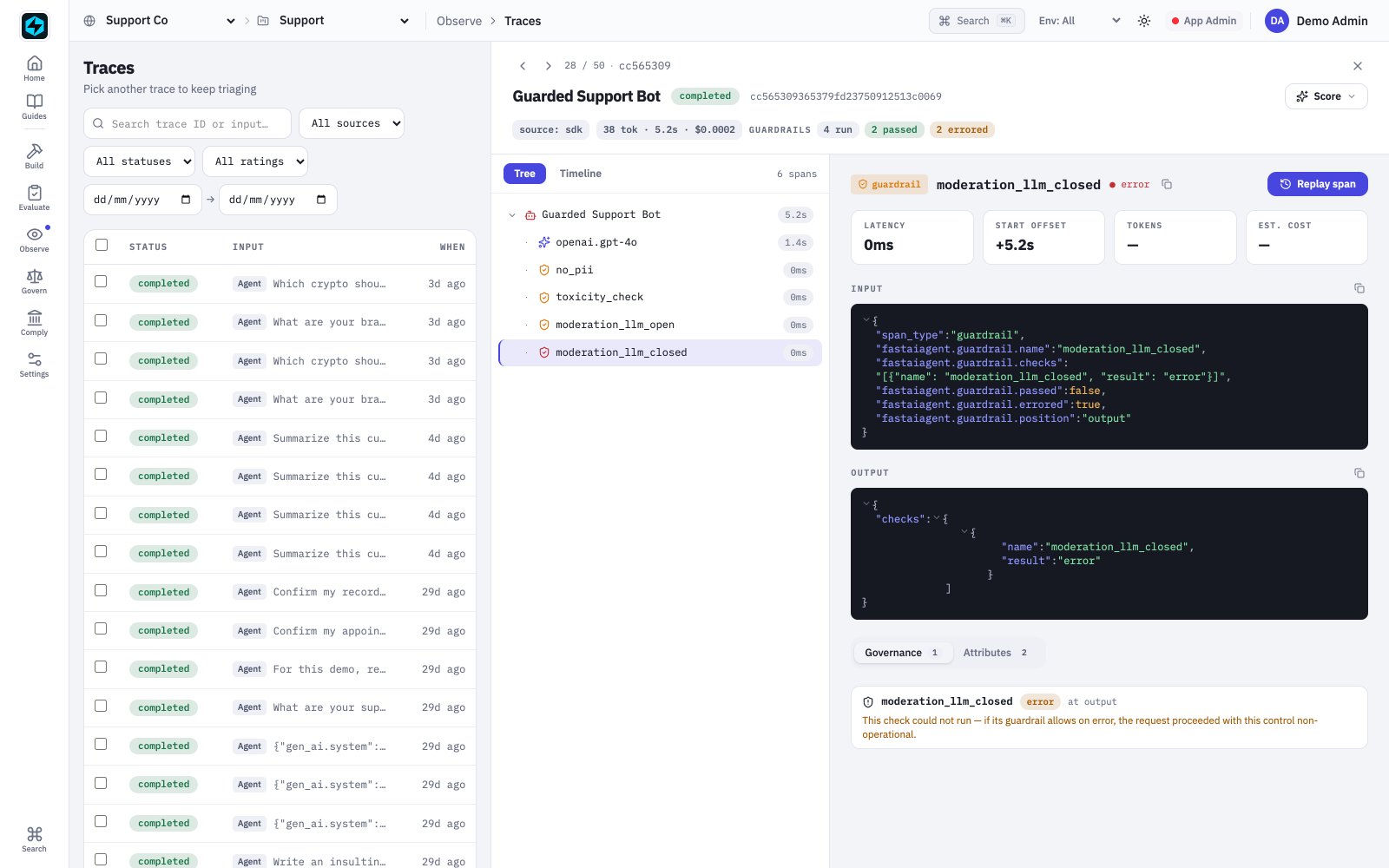
Every run from every agent lands in one place with tokens, cost and latency. Guardrail verdicts and evaluation scores sit on the exact span that produced them. Fork a real production trace, fix the prompt or tool, rerun — and the incident becomes a regression test.
Can it actually stop something? Yes.
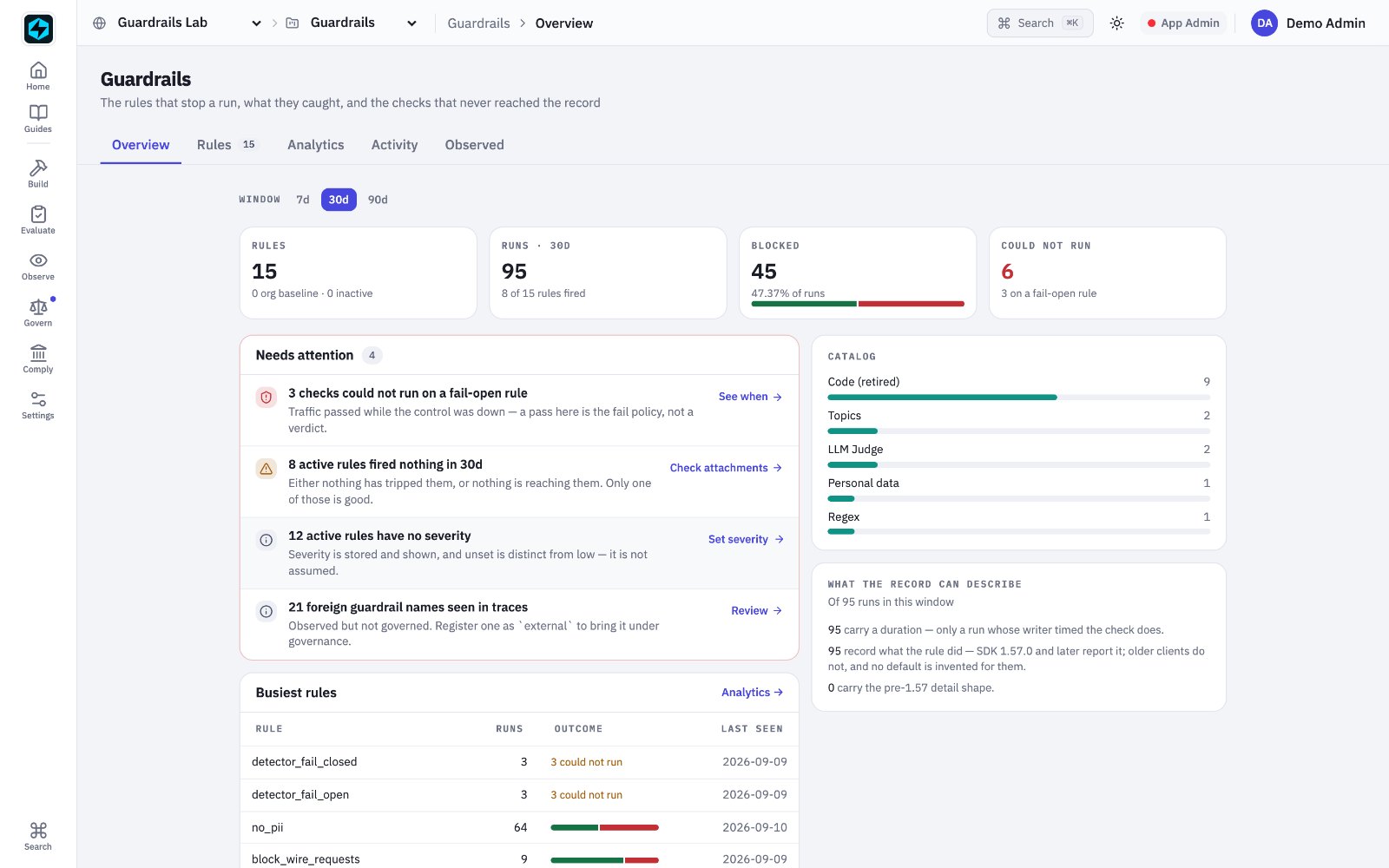
Observability tools just watch. Here, policy is checked before the agent acts — allow, deny, or require a human — and a governance error is a deny, never a silent pass. Every verdict is recorded next to the trace that produced it.
- →Ready-made templates — PII and secret detection, denied topics, content safety, groundedness, JSON schema, classifier and LLM-judge rules.
- →Actions beyond block — warn, mask, override and re-ask, with severity levels.
- →Define once, enforce everywhere — across every agent and framework; one team can never weaken a shared control.
- →Honest verdicts — a control that could not run is reported as exactly that, never folded into "passed".
Proof that a change made the agent better — and a gate that acts on it.
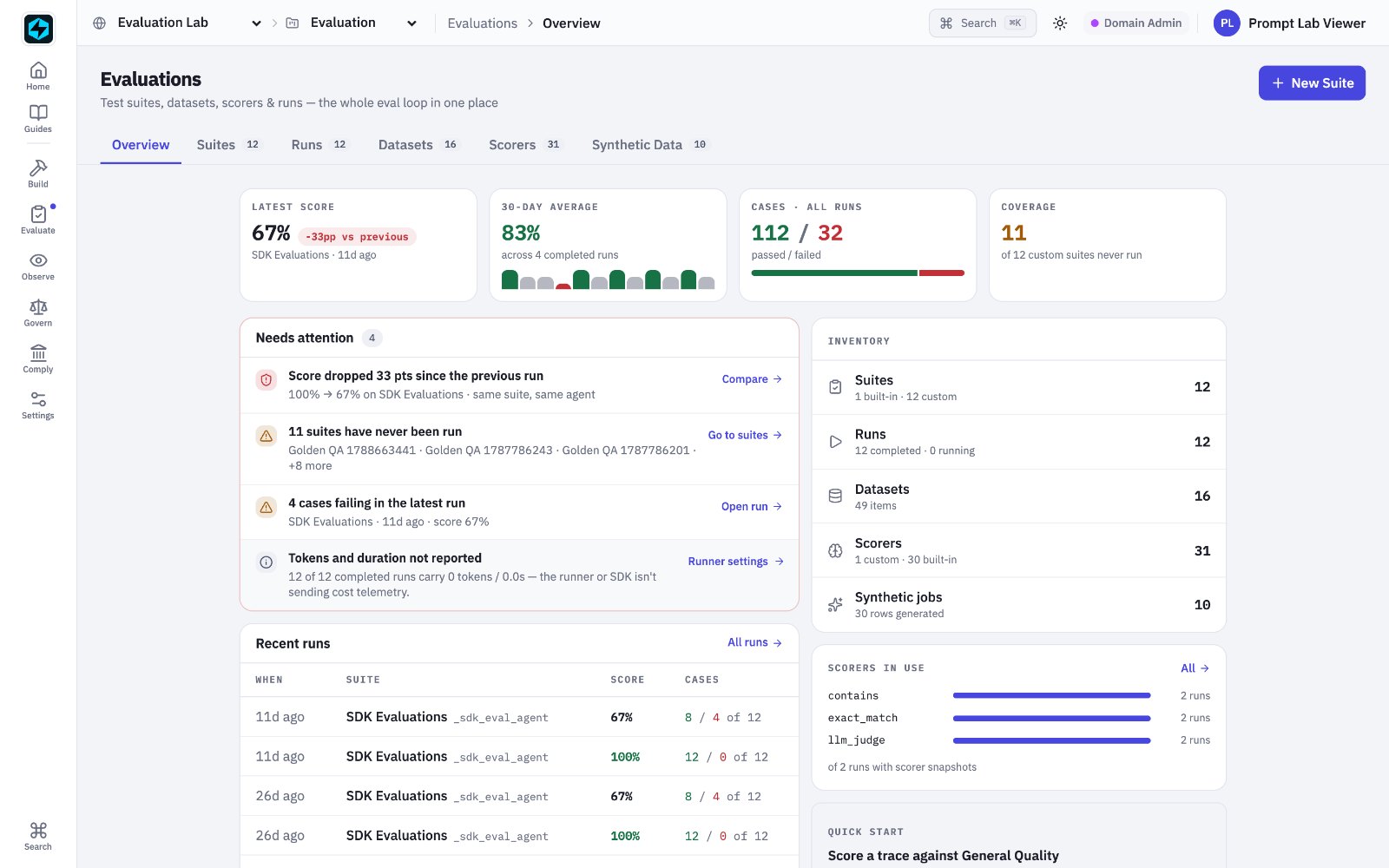
Every prompt change, model swap or tool fix gets scored before it ships. Sample live traffic continuously, compare versions side by side, and block a release that has no eval evidence behind it.
- →30 built-in scorers plus your own LLM-judge definitions; suites, cases, datasets and synthetic data.
- →Online evaluation — continuous sampling of production traffic with windowed trends.
- →A/B comparison and simulation — same input, two versions, one verdict.
- →Promotion gate — opt-in, blocks a release without eval evidence; verdicts from your own CI count too.
- →Human review that holds up — annotation queues report inter-annotator agreement, so you can show the review was consistent.
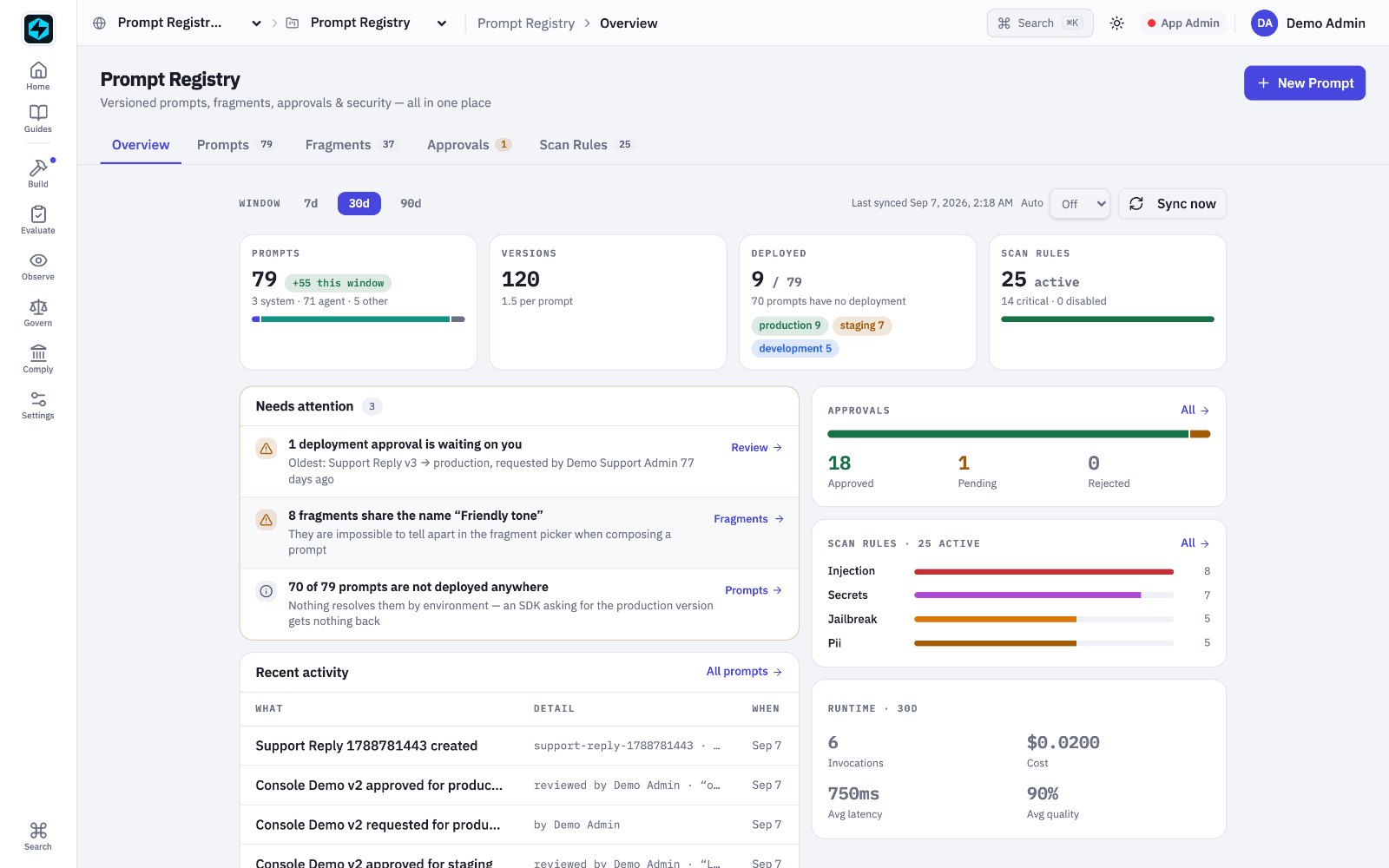
Define a prompt once. Govern it centrally.
Prompts stop living in code and chat threads. Every version is tracked, reviewed and approved to an environment before any agent can use it — and every production trace records exactly which version ran.
- →Versions and branches — semantic versioning with reusable fragments shared across prompts.
- →Approvals to environments — dev, staging, production, with a domain-wide review queue.
- →Security scans on every write — so one team can never weaken a shared control.
- →Test cases, analytics and attribution — see which version drove which outcome.
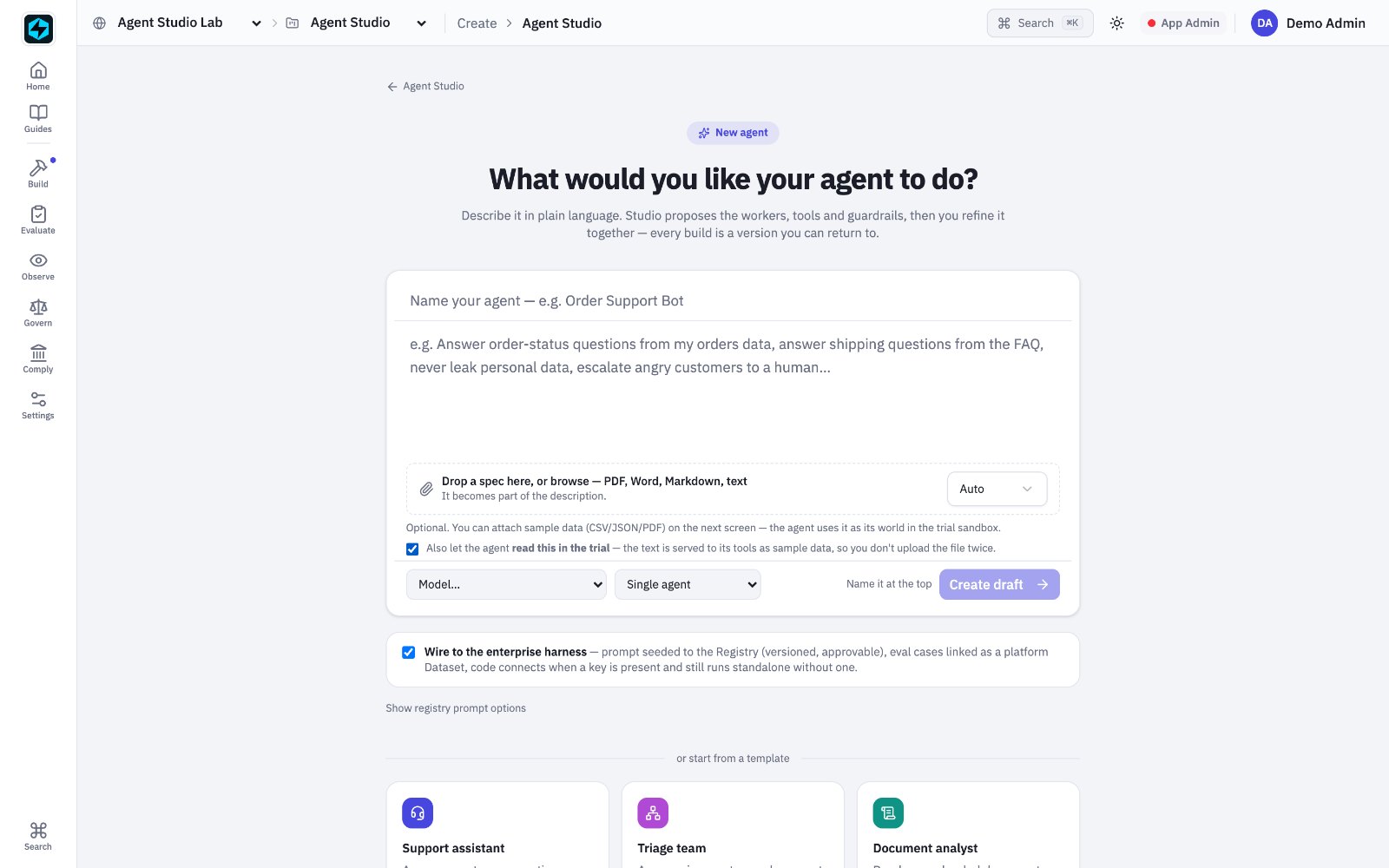
Describe an agent in plain text. Get real SDK code you own.
Studio proposes the workers, tools and guardrails, you refine it together, and every build is a version you can return to. Trial it in a sandbox with your own sample data, then export to your repo — the code is yours.
- →Wired to the enterprise harness — the prompt is seeded to the Registry, eval cases linked as a Dataset, guardrails attached from day one.
- →Runs standalone too — the exported code connects when a key is present and still runs without one.
- →Templates — support assistant, triage team, document analyst.
Govern every agent you run. Run none of them on our servers.
Most agent platforms ask you to hand over the runtime. We took the other side of that trade: your agents run on your infrastructure, and the plane only receives what they emit.
Six pillars.
{{ p.title }}
{{ p.lede }}
- →{{ i }}
Pick the side of the wire you want.
{{ d.t }}
{{ d.d }}
SDK Apache-2.0, works with no plane at all. Enterprise plane proprietary. Coupled by the wire contract alone.
{{ a.a }}
Every other agent platform asks you to move your runtime. This one asks for your telemetry, and gives you back control.
See it against your own agents, or start with the open-source SDK and connect the plane later. We reply from support@fastaifoundry.com.