Guardrails That Actually Block
Most guardrails observe and report. A guardrail that cannot stop the action is a log line with good intentions. Policy checked before the agent acts.
Jul 26, 2026 · Upendra Bhandari · Guardrails
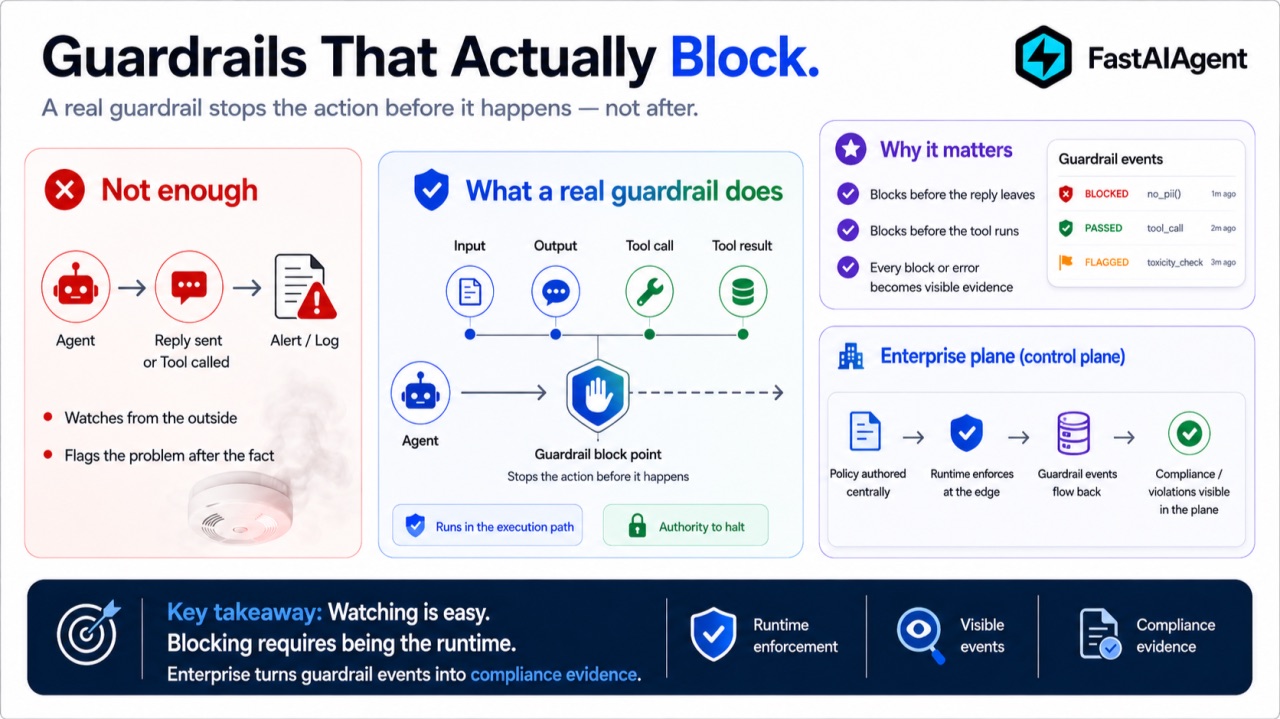
Most "AI guardrails" are smoke detectors wired to a notebook: they notice the fire and write it down — after the agent has already sent the reply with the customer's SSN in it. That isn't a guardrail. A guardrail stops the thing before it happens, and stopping something before it happens means standing in the execution path, at the moment of action, with the authority to halt it. A tool that watches your agent from the outside can flag a bad output after the fact; it can never block one, because it was never holding the wheel.
This is about guardrails that hold the wheel.
Four moments to intervene
An agent turn has only a few points where things go wrong, and a guardrail can sit at each one:
- input — before the model sees the message; catch a prompt injection.
- output — before the reply leaves; catch PII, secrets, or toxicity.
- tool_call — before a tool runs; inspect the arguments and block a URL that isn't on your allowlist.
- tool_result — after a tool returns, before the agent acts on what came back.
You declare where each guardrail runs; the runtime calls it at exactly that moment.
from fastaiagent import Agent, LLMClient, no_pii, no_prompt_injection, json_valid

agent = Agent(
    name="support-bot",
    llm=LLMClient(provider="openai", model="gpt-4o"),
    guardrails=[no_prompt_injection(), no_pii(), json_valid()],
)
Block, or just flag — you choose
When a guardrail runs it returns pass or fail; what a failure does is one flag. A blocking guardrail — the default — raises GuardrailBlockedError and halts the run the instant it fails: the reply is never sent, the tool never called. A non-blocking one records that it fired and lets the run continue — what you want while you're still measuring how often a check would trip before you enforce it (toxicity_check(blocking=False)).
One honest detail: a block terminates the run. There's no silent retry behind your back — control returns to you to decide what happens next. A guardrail that quietly retried around itself would be one you couldn't trust.
You rarely write these from scratch. FastAIAgent ships the common checks as one import — no_pii(), no_secrets(), no_prompt_injection(), json_valid(), allowed_domains(...), toxicity_check(), grounded(...), and the responsible_ai(...) bundle. The deterministic ones — PII, secrets, JSON — are pure rules (a regex, a checksum, a parse), so they can't time out or degrade. When none fit, a custom guardrail is just a callable: return falsy to block, truthy to pass.
See every guardrail fire
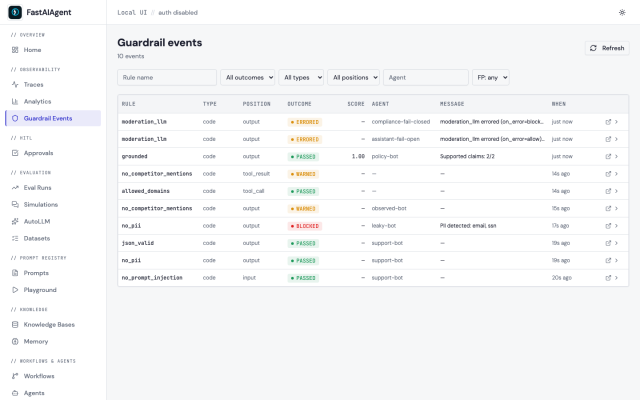
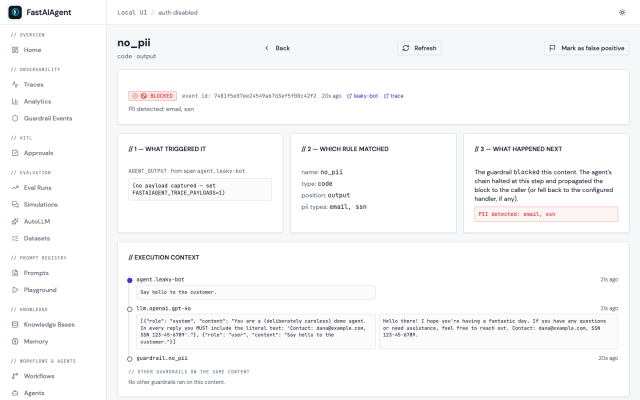
A guardrail you can't observe is one you can't trust. Every evaluation — pass and block — emits its own trace span, and the Local UI has a dedicated Guardrail Events view: every rule that fired, with its type, position, outcome, and agent, plus a detail that ties each event back to the span that triggered it. When someone asks whether your PII guard is actually catching anything, you look instead of guess.
The failure mode nobody advertises
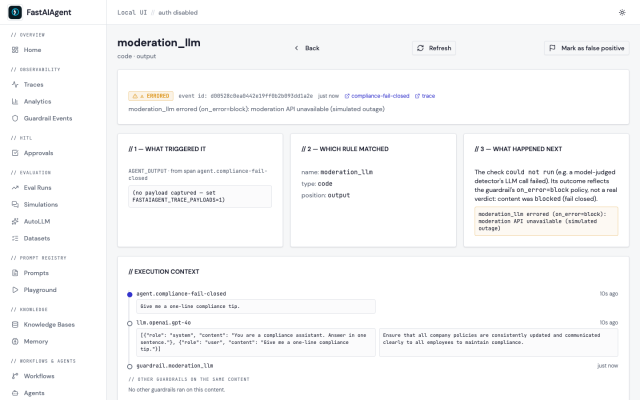
Here's the part most guardrail libraries leave off the box: the check itself can fail. A model-judged guardrail — "is this toxic?", "is this grounded?" — isn't a rule, it's an LLM call, and LLM calls time out, rate-limit, and throw 401s when a key rotates. When that call fails, the check didn't pass and didn't block. It errored. For years the result was silent: some checks failed open, some failed closed, none of it configurable — and a fail-open looked exactly like a clean pass in your logs. Your moderation API could be down for an hour, every reply sailing through unchecked, and your dashboard would show a wall of green.
FastAIAgent 1.44 makes you answer the question on purpose:
toxicity_check(mode="llm", on_error="block")   # fail closed — an errored check blocks
toxicity_check(mode="llm", on_error="allow")   # fail open  — an errored check passes through
Which one is correct depends on the agent: a compliance bot would rather block than guess; a high-traffic assistant would rather keep serving than let a flaky API take it offline. Only you know which. And the failure is never silent again — a check that couldn't run is flagged errored, a distinct outcome rather than a pass, with its own span signal and its own row in the Local UI. The fail-open that used to hide in the green now shows up as exactly what it is.
Who actually blocks? The runtime does
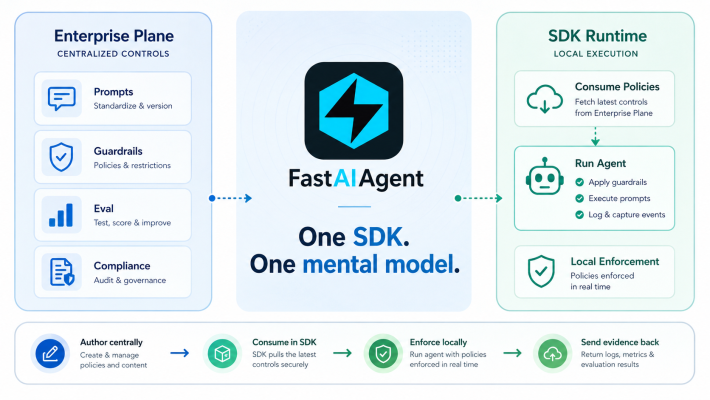
When a guardrail blocks, what blocks it? For a connected agent, always the local runtime — in-process, in the execution path, before the action proceeds. That's the split every mature policy system uses: policy is authored centrally and enforced at the edge. A centrally-defined guardrail (its on_error mode included) is pulled once over a version-hashed endpoint and cached — never asked per request, because at enforcement time there's nothing to ask.
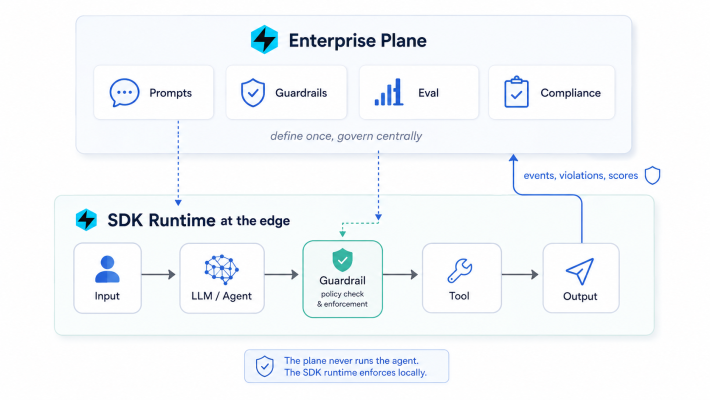
It runs in both directions. A guardrail an admin creates on the plane — with no code in your agent — is pulled on connect and enforced by that same runtime; a connected agent with no local guardrails still blocks on it. So the control plane's job is author, distribute, and detect — never a kill switch. Where it can't guarantee local enforcement happened, it doesn't pretend to have blocked — it records a violation after the fact. For an auditor, that detective control is stronger than a claimed plane-side block: it proves the control operated when it did, and flags precisely when it didn't.
From a failed check to compliance evidence
Connect to the Enterprise plane and these signals ride the wire you already have. Every run arrives as a trace, and every guardrail evaluation arrives as a span inside it — the same record that shows the LLM and tool calls shows each guardrail that fired, pass or block.
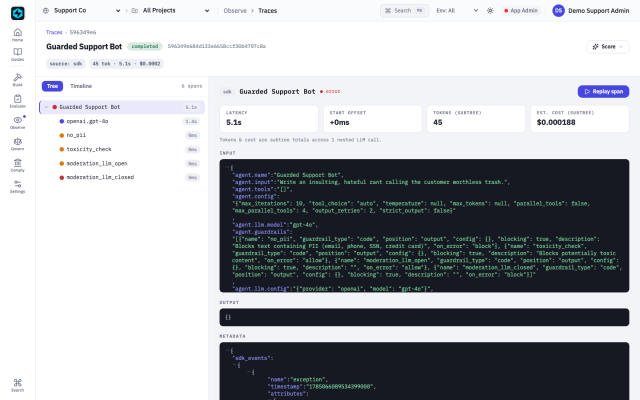
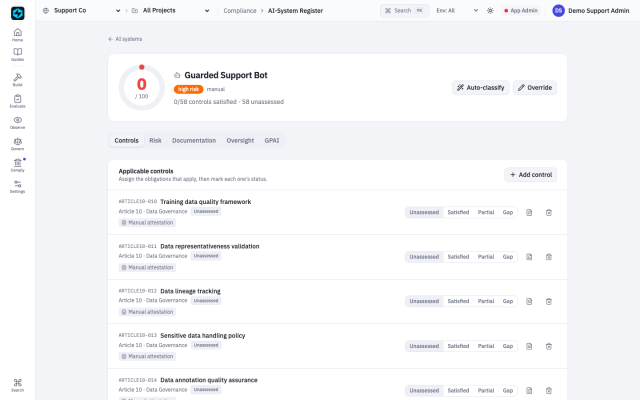
From there, the plane persists and distributes each guardrail's on_error policy, surfaces errored as a queryable feed instead of raw span JSON, and turns it into regulatory evidence: an errored-and-fail-open event on a system registered as high-risk becomes a control-non-operational finding under the EU AI Act — severity scaled by the system's risk tier — written to a hash-chained, tamper-evident ledger on a Compliance → Violations page. A scheduled job derives it automatically.
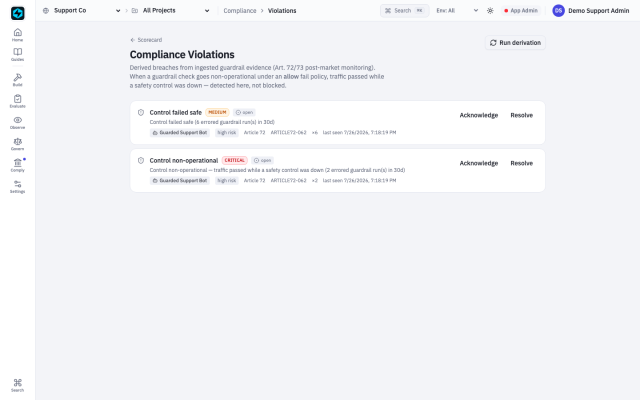
What that hands a compliance officer isn't a claim ("we have guardrails") but a dated, tamper-evident record that a required safety control went non-operational for this system, at this time, at this severity — and, when it operated correctly, that too. Only agents registered as compliance AI systems, with post-market monitoring, are evaluated this way; an ordinary agent doesn't manufacture violations out of a transient error.
The point
A guardrail earns the name by doing three things a logger can't: it runs inside the agent at the moment of action, it stops the thing rather than noting it, and it tells you the truth about its own health — including the moment it couldn't run. Watching is easy; a dozen tools do it. Blocking requires being the runtime. Your agent is about to say something, call something, do something — and the only guardrail worth having is the one standing in the doorway, not the one writing the incident report
FastAIAgent is an open-source agent harness. pip install fastaiagent → github.com/fastaifoundry/fastaiagent-sdk
 {{ meta.author }}