Your Agents Answered Ten Thousand Customers. How Many Has Anyone Read?
Most teams rely on an LLM judge to grade the rest, and nobody has checked whether the judge is right. When someone asks who reviewed this, a model's score is not an answer.
Sep 16, 2026 · Upendra Bhandari · Evaluation
Your agents answered ten thousand customers this week. How many of those answers has anyone on your team actually read?
Most teams rely on an LLM judge to grade the rest, and nobody has checked whether the judge is right. When a regulator, a customer or your own board asks "who reviewed this", a model's score is not an answer.
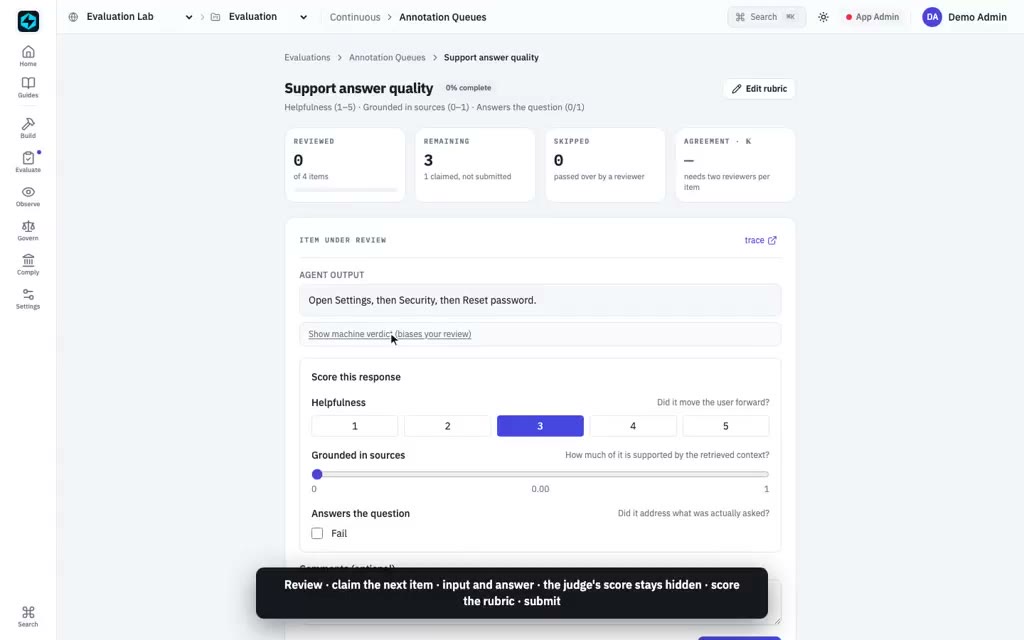
This short video shows how FastAIAgent closes that gap: a human review queue with a rubric, traces sent in with one click and every verdict compared against the automated judge. Where they agree, you can trust automation at scale. Where they disagree, you know exactly where the agent needs work. And every review is on the record: who checked what, and what they decided.
Human judgment, beside the machine's.
The review queue, end to end
One detail worth pausing on: the machine verdict stays hidden behind a link marked biases your review. A reviewer who sees the judge's score first is no longer an independent check on it — which is the entire point of having one.
The wider argument is in Why ship an agent without evals?, which covers scorers, datasets and the agreement statistics that tell you whether your judge can be trusted. For approvals in the execution path rather than after it, see Your agent shouldn't decide alone.
 {{ meta.author }}