Agent = Model + Harness.
The model is the engine. The harness is the car. FastAIAgent is the open agent harness — a runtime that calls the model, a memory store you own, a workspace where humans approve, and a governance plane that keeps it all auditable. One stack. One spec.
One harness. Nine layers.
A production agent isn't a model — it's a model wrapped in scaffolding that gives it tools, memory, oversight, and accountability. Use one layer. Use all nine. Click a layer to see what's inside.
{{ cur.headline }}
{{ cur.lede }}
Six features. One closed loop. Zero context switching.
Most teams stitch together 3–4 tools to go from a failing agent to a fixed one. FastAIAgent is the only platform where trace, feedback, eval, optimization, comparison, and deployment happen in a single closed-loop system — so every production failure becomes a shipped improvement, not a fire drill.
Fork. Fix. Rerun. From failing trace to fixed agent in 10 minutes, not 4 hours.
Step through any agent execution span-by-span. See exactly what the agent thought, which tools it called, what context it had — and fork from any point to explore “what if?” scenarios. Save the corrected run as a regression test, so every production failure becomes a permanent test. Available in both the SDK and the platform.
from fastaiagent.trace import Replay

replay = Replay.load("trace_abc123")   # a production failure
replay.step_through()
# Step 3: LLM hallucinated the refund policy ← found it

forked = replay.fork_at(step=3)
forked.modify_prompt("Always cite the exact policy section...")
result = forked.rerun()

result.save_as_test("regression_tests.jsonl")  # caught forever
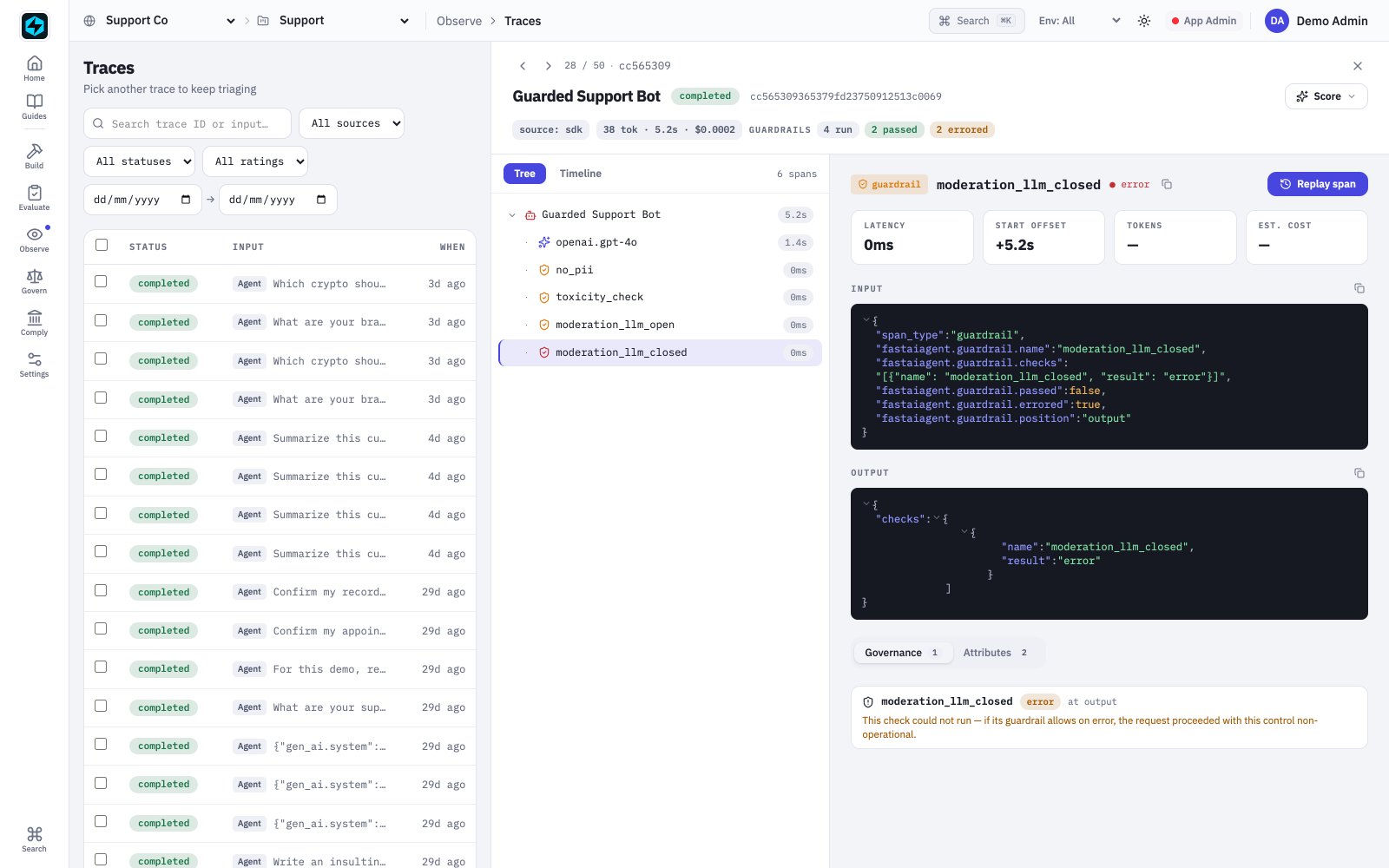
Write Python, or describe it. Either way the code is yours.
Whether you write Python or build in a UI, you get the same trace dashboard, the same prompt registry, the same eval framework.
Build agents in Python. Run locally.
The fastaiagent SDK is open-source (Apache 2.0) and runs anywhere Python runs. Start standalone — add the platform later with a single fa.connect() call.
import fastaiagent as fa

fa.connect(api_key="fa_k_...", project="my-project")  # optional

agent = fa.Agent(
    name="support-bot", model="gpt-4o",
    system_prompt="You are a helpful support agent.",
    tools=[search_kb, create_ticket],
    guardrails=[pii_filter, toxicity_check],
)
result = await agent.run("I can't log in to my account")
# Traces auto-export · prompts pull from registry · evals publish back
Describe it in Agent Studio. No SDK required.
Describe an agent in plain text — the studio generates real, open SDK code you can trial in a sandbox and export to your repo. Configure connectors, test in the Playground, monitor in the dashboard.
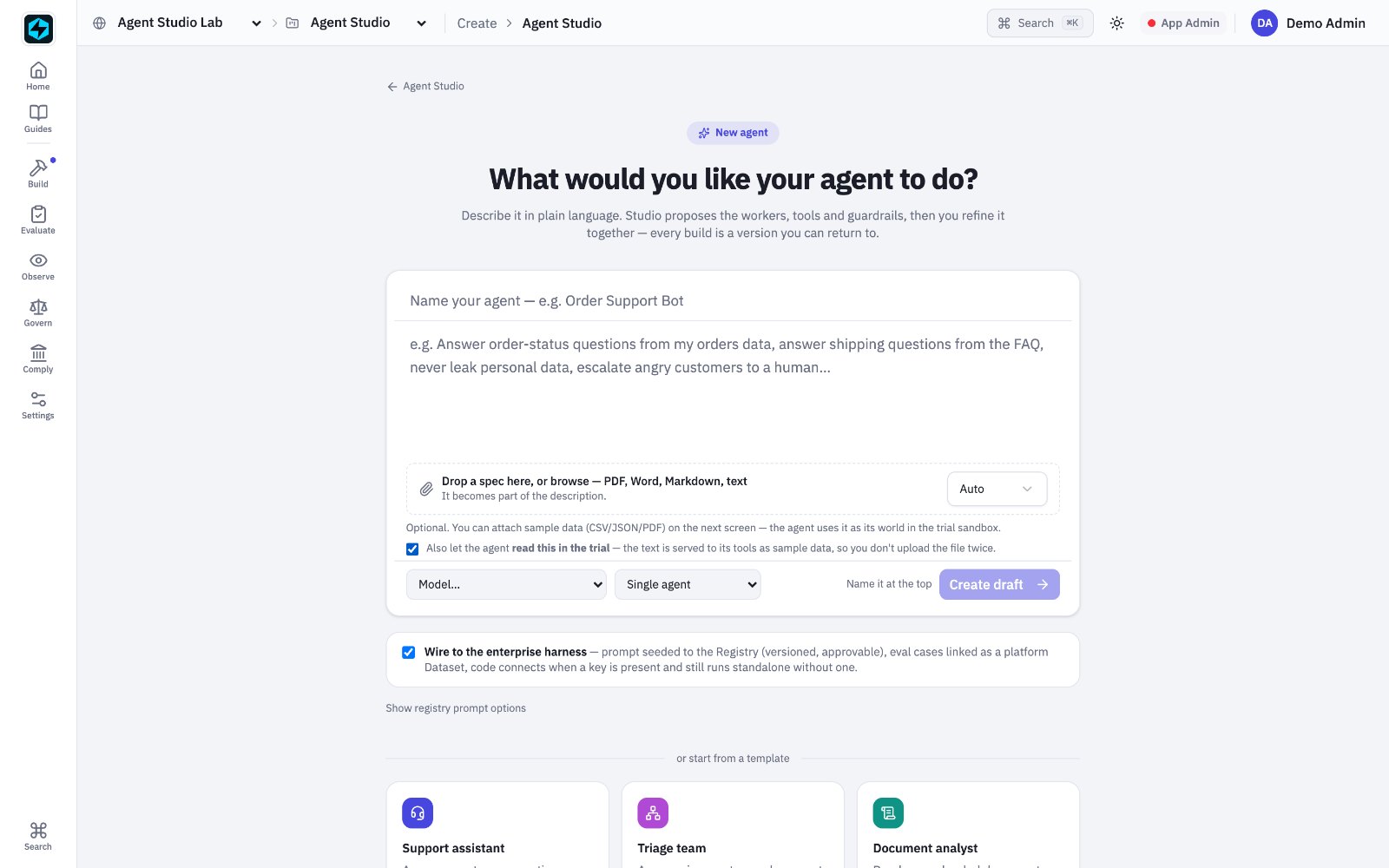
No vendor lock-in — bring your own models, tools, and infrastructure.
The model is one piece. Everything else is the harness.
Swap the model anytime. The runtime keeps calling, the memory keeps grounding, the workspace keeps approving, the policy keeps holding. That's what an open harness gets you: a stack where the most volatile component (the model) is the only piece you ever rip out.
Open harness. Pluggable. Portable. Yours.
The closed harnesses (you know the ones) lock the model, the memory, and the workflow inside the vendor. Ours doesn't. Here's the diff, line by line.
Compliance from the trace, not a separate product.
4-role RBAC, SSO, encrypted secrets, audit trails, air-gapped deployment, and EU AI Act compliance. The governance plane consumes the registry, traces, and evals already running — so the paper trail ships itself. No cloud dependency. No vendor lock-in. Your data stays yours.
- →EU AI Act — high-risk classification, 19-role accountability, conformity assessment, regulatory reporting.
- →Audit trail — who did what, when; every decision linked to prompt, model and memory version.
- →Human approval — consequential actions pause for a person before they happen.
Builders wire it. Operators ride it. Compliance signs off on it.
The harness has a seat for everyone in the loop. Each role gets the surface they need — the same data plane underneath.
{{ r.title }}
{{ r.body }}